Prepare for Your California Small Claims Hearing
If you have been served with a California Small Claims lawsuit, preparing for your hearing is an important part of the process.
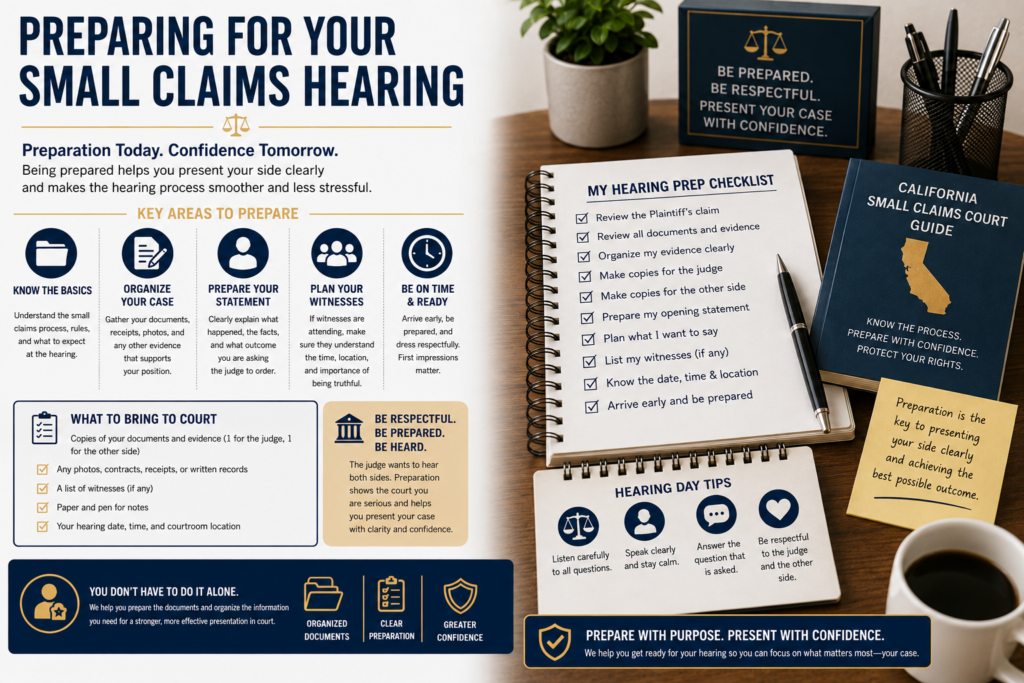
Before your hearing, take time to review your court documents, organize your records and other materials, and become familiar with what to expect when you appear in court.
SmallClaimsCourt.Expert provides California-focused educational information and permitted legal document preparation services for individuals and small businesses representing themselves in Small Claims Court.
Office: 949-208-1567
Email: help@smallclaimscourt.expert
1. Review Your Court Documents
Start by reviewing the documents you received when you were served.
Pay attention to information such as:
- The name of the plaintiff.
- The name of the defendant.
- The court where the case was filed.
- The case number.
- The hearing date and time.
- The court location and courtroom information.
- The amount being claimed.
- The description of the dispute.
- Any attachments or other documents included with the claim.
The California Courts Self-Help Guide explains that the Plaintiff’s Claim and Order to Go to Small Claims Court (form SC-100) identifies who is suing you, how much is being requested, and why the plaintiff is bringing the claim.
Keep your court papers together and bring the documents you need with you when you attend your hearing.
2. Organize Your Records
As you prepare for your hearing, organize documents and other materials relating to the dispute.
Depending on the circumstances, your records may include:
- Contracts or agreements.
- Receipts and invoices.
- Photographs.
- Emails.
- Text messages.
- Letters or other correspondence.
- Business records.
- Repair records.
- Payment records.
- Other documents relating to the dispute.
California Courts recommends organizing papers so they can be located easily if the judge asks to see something during the hearing.
Keep your original records in a safe place and make copies as appropriate for your hearing.
3. Organize Your Exhibits
Documents, photographs, and other materials that you present to the court may be considered exhibits.
California Courts explains that exhibits must be admitted into evidence before the judge can use them in deciding the case, and courts may have specific procedures for labeling and presenting exhibits.
Before your hearing, organize your materials so that you can locate them easily.
Your court may have specific procedures concerning exhibits. Check with the court handling your case for instructions that apply to your hearing.
4. Prepare Your Hearing File
A simple organizational system can make it easier to locate documents during your hearing.
You may wish to organize your materials into sections such as:
Section 1 — Court Documents
Your Small Claims papers and other documents received from the court.
Section 2 — Claim and Service Documents
The Plaintiff’s Claim and information concerning service.
Section 3 — Documents
Contracts, receipts, invoices, correspondence, and other records.
Section 4 — Photographs and Other Exhibits
Photographs and other materials you may need to present to the court.
Section 5 — Additional Materials
Other documents relating to the matter.
The exact materials appropriate for your situation will depend on the circumstances of your case.
5. Consider Your Witnesses and Evidence
California Courts explains that you may need witnesses or evidence for your hearing. If someone will not voluntarily provide information or appear at the hearing, a subpoena may be available to require their appearance or the production of documents.
Small Claims subpoena procedures have specific requirements, including having the court issue the subpoena and properly serving it.
If you believe you need a subpoena, review the current California Courts instructions or speak with the court clerk about the applicable procedure.
SmallClaimsCourt.Expert does not determine which witnesses you should use, which evidence you should present, or whether particular evidence will help your case.
6. Become Familiar With the Court Process
Before your hearing, review the information provided by the California Courts and the court where your case is pending.
You may also want to learn:
- Where the courthouse is located.
- Where to park.
- Where your courtroom is located.
- Whether you need to check in.
- What security procedures apply.
- Whether your hearing is in person or remote.
- Whether the court has specific instructions concerning documents or exhibits.
California Courts recommends arriving on time or early enough to allow for parking, courthouse security, locating the courtroom, and checking in when required.
7. Prepare to Explain Your Side
At a Small Claims hearing, the parties have an opportunity to present information to the judge.
California Courts recommends reviewing the forms filed in the case and preparing what you plan to say before your hearing.
You may find it useful to make a simple outline of the facts and events you want to remember.
However, SmallClaimsCourt.Expert does not prepare legal arguments, determine legal defenses, develop litigation strategy, or tell you what you should say to the judge.
If you need advice about your legal rights, defenses, arguments, or legal strategy, you should consult a qualified California attorney.
8. Check Your Court’s Instructions
Court procedures can vary, and your court may have instructions that apply specifically to your hearing.
Before appearing, check the court’s current information for:
- Hearing procedures.
- Remote-hearing requirements, if applicable.
- Exhibit requirements.
- Document submission procedures.
- Courthouse rules.
- Any other instructions provided by the court.
For current California Small Claims information, forms, and self-help guidance, visit the California Courts Self-Help Center.
9. What to Bring to Court
Review your court documents and your court’s instructions before deciding what materials to bring.
Generally, you should have your important court papers and organized supporting materials available for reference.
California Courts recommends having your original paperwork for yourself, a copy for the judge, and a copy for the other side when appropriate.
If your hearing is remote, the court may have different procedures for submitting or sharing evidence. Contact the court if you need instructions about submitting documents for a remote hearing.
10. At the Courthouse
Give yourself enough time to arrive, park, go through security if required, locate your courtroom, and check in.
When your case is called:
- Follow the judge’s instructions.
- Listen carefully.
- Speak clearly and respectfully.
- Do not interrupt the judge or the other party.
- Have your documents organized and readily available.
California Courts explains that when a case is called, the parties have an opportunity to speak to the judge and that the judge may make a decision at the hearing or later issue a decision.
How SmallClaimsCourt.Expert Can Help
If you are representing yourself in a California Small Claims matter, SmallClaimsCourt.Expert provides permitted legal document preparation and self-help services.
Depending on the service requested and the information and instructions you provide, our services may include:
- Preparing documents at your specific direction.
- Assisting with the completion of documents based on information you provide.
- Formatting and organizing documents.
- Organizing client-provided materials and exhibits.
- Providing general procedural information.
- Assisting with filing and service at your specific direction.
What We Do Not Do
SmallClaimsCourt.Expert does not:
- Provide legal advice.
- Represent clients in court.
- Determine legal defenses.
- Evaluate the legal merits of a particular case.
- Develop legal strategies.
- Tell a client what arguments to make.
- Decide which evidence or witnesses a client should use.
- Coach a client regarding testimony.
- Tell a client what legal option they should choose.
Clients make their own legal decisions and provide the information and instructions used in document preparation.
If you need legal advice concerning your particular circumstances, consult a qualified California attorney.
Need Help Preparing Your Documents?
If you have been served with a California Small Claims lawsuit and need permitted document preparation assistance, you can schedule an appointment with SmallClaimsCourt.Expert.
Appointments are available in Irvine or online.
[Schedule a Document Preparation Appointment]
Important Disclaimer
SmallClaimsCourt.Expert is not a law firm. We are not attorneys and do not provide legal advice or legal representation. We are a California-registered Legal Document Assistant and provide legal document preparation and other self-help services permitted under California law.
Information on this page is provided for general educational purposes and is not legal advice. Reading this page, contacting us, or using our services does not create an attorney-client relationship.
If you need legal advice regarding your particular situation, you should consult a qualified California attorney.